In this existence, everything is subject to the vicious cycle of birth and death. Even stars for instance, has a beginning and an end. Nothing is permanent and beyond any doubt, nothing comes into existence out of the blue. There are regions in our universe, violent regions, comprising of clouds of dust and gases. These are the regions where stars are born. Such regions are known as Nebula (pl. Nebulae). These are very violent places where gravity pulls together accumulation of dust and hot gases. These clumps keep on growing in size until it collapses from its own gravity and causes the material at the center to heat up, thus marking the beginning of a star. These chaotic regions are huge in size and measures light years across. They are situated thousands of light years away from us and cannot be seen by unaided eye except for very few. In order to see these regions, we have to take long exposure images from DSLR cameras or Astro-dedicated cameras, whose sensors are very sensitive to the light emitted by these regions in the interstellar space.
Nowadays, there are special narrowband and broadband light pollution filters available to tackle light pollution in the city areas. For example, the commonly used Hydrogen-Alpha (Ha) narrowband filter, is designed to transmit a specific deep-red visible spectral line with a wavelength of 656 nm and block out all the spectrums of light. In space, Hydrogen is abundant and most of the nebulae in our night sky emit a strong signal of light in this wavelength and this filter helps isolate it before hitting your camera sensor. Likewise, there are other filters as well that are specific to Oxygen and Sulphur.
So, let’s go back in time and travel to the regions where stars are born.
A Continent in Space
Seated in the Cygnus constellation, the North America Nebula, catalogued as NGC 7000, lies approximately 2,000 light years away from Earth, close to a bright star Deneb. It is a large emission nebula that resembles the shape of North America continent (including the Gulf of Mexico). An emission nebula is a cloud of ionized gas and is normally referred to as HII region (H-two region). Ionized hydrogen is produced when the ultraviolet radiations released from hot newly-born stars ionizes surrounding clouds of gas.
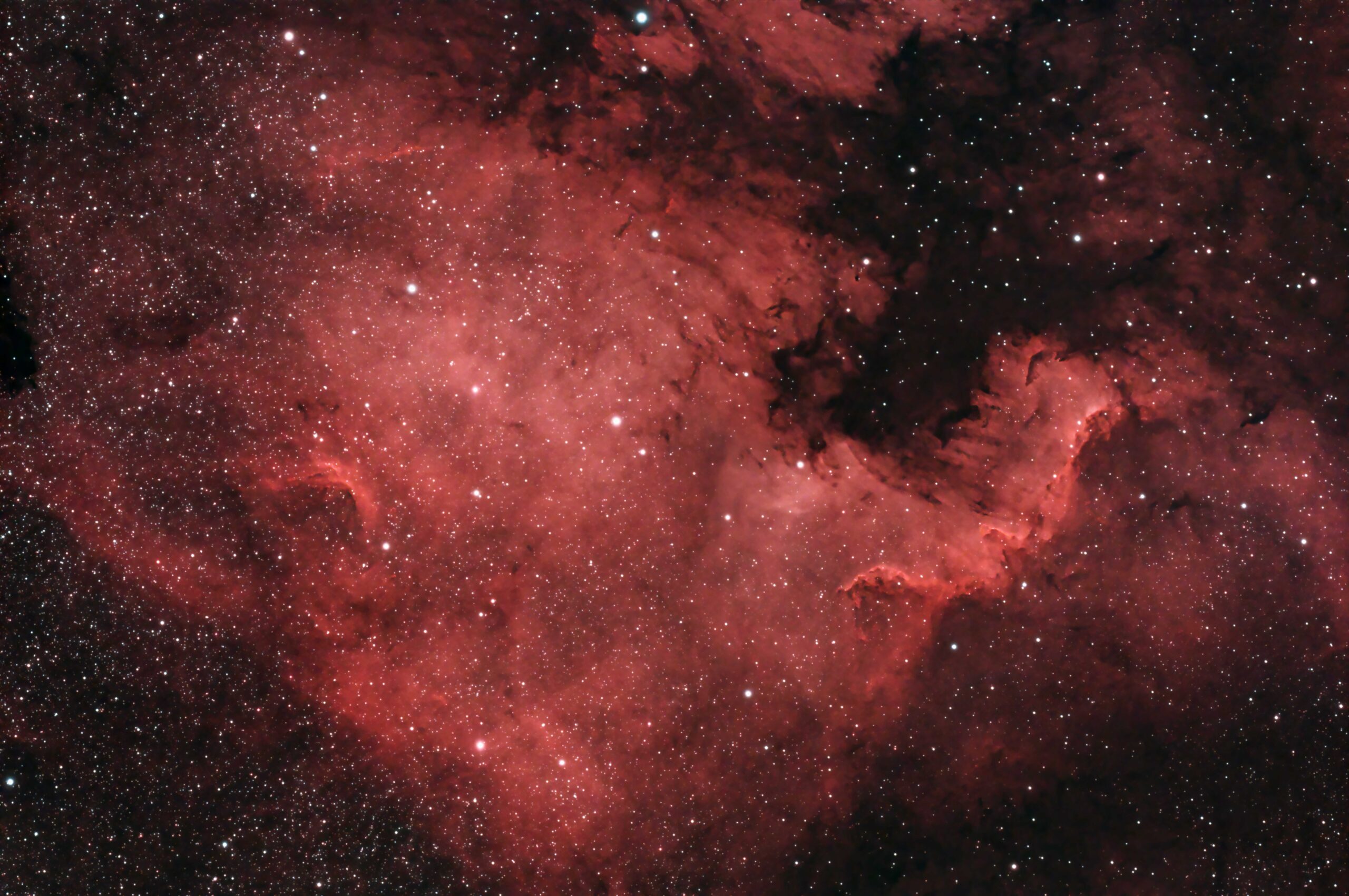
Look closely on the top, the Pelican is really trying hard to sneak into the portrait of NGC 7000. It certainly deserves an exclusive feature. This above image was captured under heavily light polluted sky in the middle of the city (Bortle Class 9). During that time, the city was also covered in smoke (air pollution). I was able to produce this result only with the help of Optolong L-enhance filter, which is a tri-band pass filter that effectively isolates H-Alpha, H-Beta and Oxygen III (OIII) nebula emission lines, and blocking out the other spectrums of light.
Acquisition details:
36 x 240s
17 x 180s
Total Integration time : 3 hours 15 minutes
Gain : 111
Offset : 8
Camera Sensor Temperature : -10℃
Equipment used:
William Optics Redcat 51
ZWO ASI 183MC PRO
Optolong L-enhance 2″ filter
Ioptron CEM26
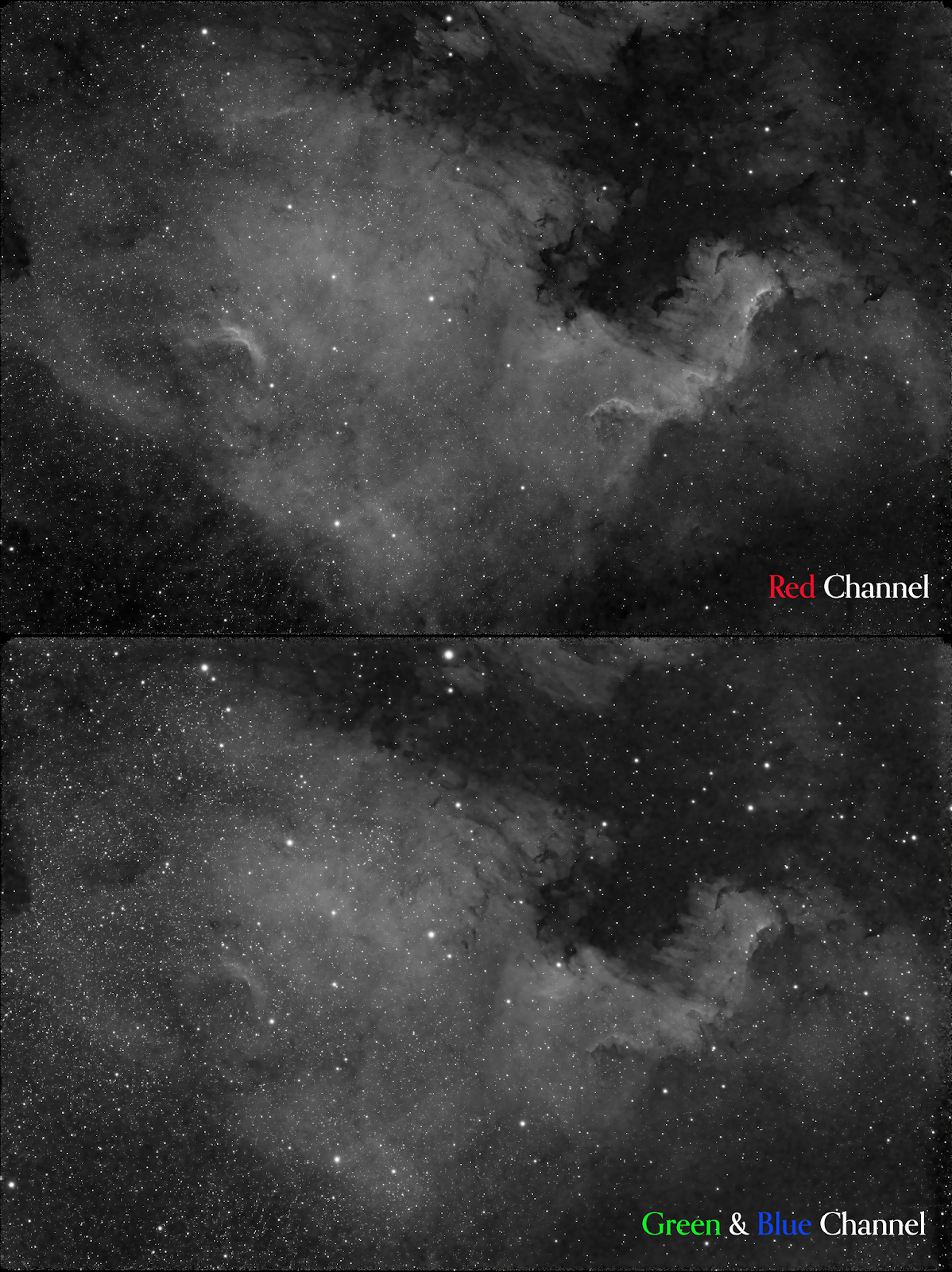
The L-enhance filter is specially designed for the colour cameras, where the light emitted from the ionized Hydrogen gas (Ha) from space mostly gets recorded in the Red filter (R) on the pixel array of CMOS sensor and H-Beta and Oxygen (OIII) spreads across Green and Blue filters (GB). In the above image (b), the Red channel contains the hydrogen data and Green & Blue channels contain both H-Beta and OIII data.
Here, the method I have used in the stacking software extracts Hydrogen and Oxygen, resulting into greyscale images, and later, these two images are copied and pasted into their corresponding RGB channels in Adobe Photoshop, to produce colour images.
October, 2021
Pelican Nebula
As promised, the cosmic bird finally gets an exclusive feature. By now, you would have guessed the reason behind its name. It resembles the shape of Pelican. This active star-forming region is also an emission nebula (HII region) situated adjacent to NGC 7000, and lies approximately 1,800 light years away from Earth.
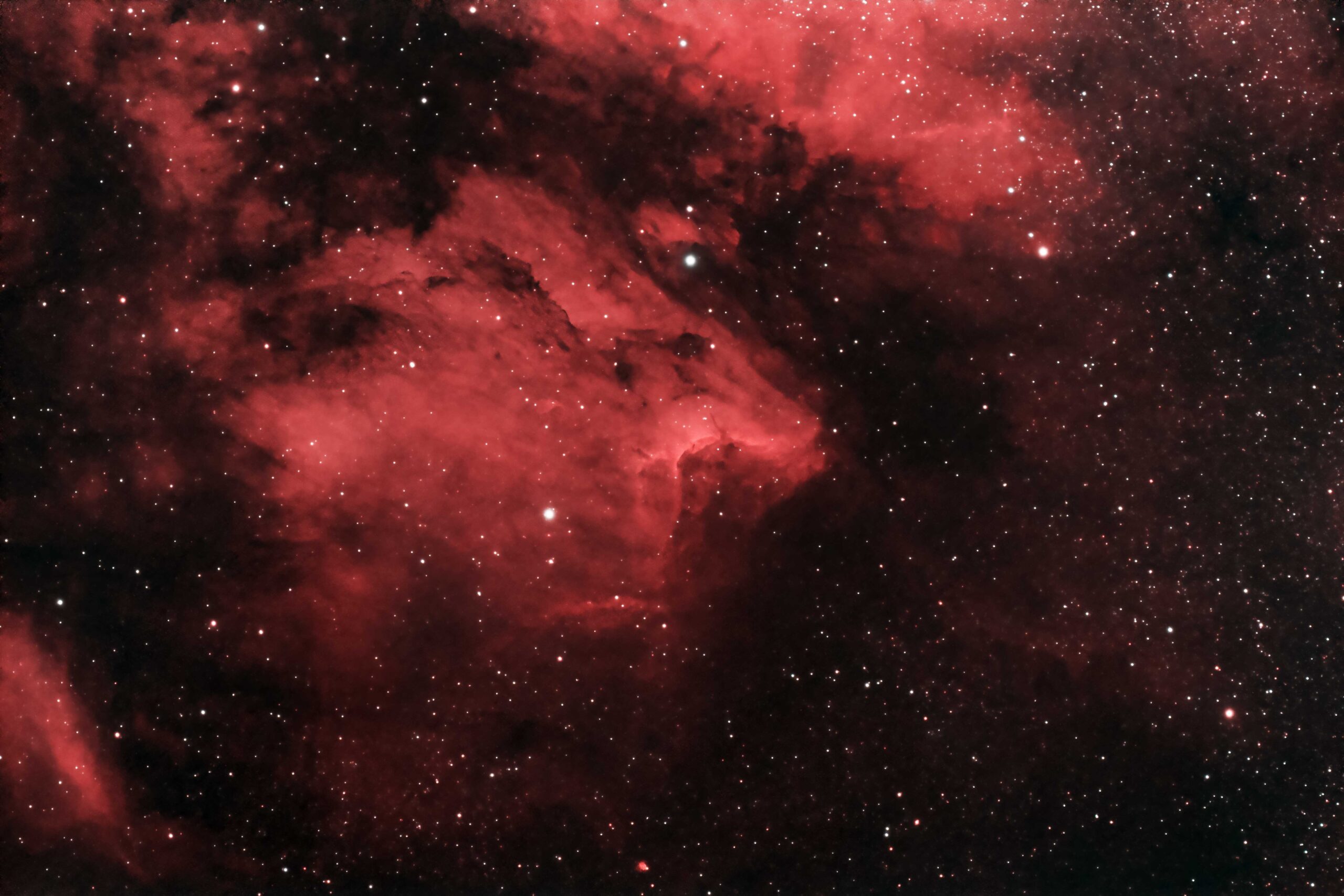
I had spent 4 nights capturing this target using L-enhance filter. This image was captured using the same equipment as I have mentioned above.
Acquisition details:
52 x 300 seconds
17 x 360 seconds
Total Integration time : 6 hours
Gain : 111
Offset : 8
Camera Sensor Temperature : -10℃
Sometimes, it takes more number of nights depending upon the weather conditions. These two targets (NGC 7000 and Pelican Nebula) were photographed separately under the smoky sky conditions due to the limited field of view (FOV) of my camera sensor. My plan was to do a two-panel mosaic in the month of May itself, but we had terrible weather immediately after I was done with NGC 7000, and severe humidity (around 85%) did not allow me to use my cooled Astro-dedicated camera, fearing it might lead to condensation on the sensor.
This mosaic was my great cosmic plan for 2021. I kept reminding myself that “I will accomplish what I had planned months ago, come hell or high water!” For 5 months, I couldn’t do what I love the most, and that literally felt like a curse. The wait was long, but the fire inside me only burned brighter. It was the last week of October, 2021 when the sky finally opened up and the moment humidity subsided, I immediately rushed to the roof and set up my imaging rig, and started collecting photons of Pelican region.
The Mosaic
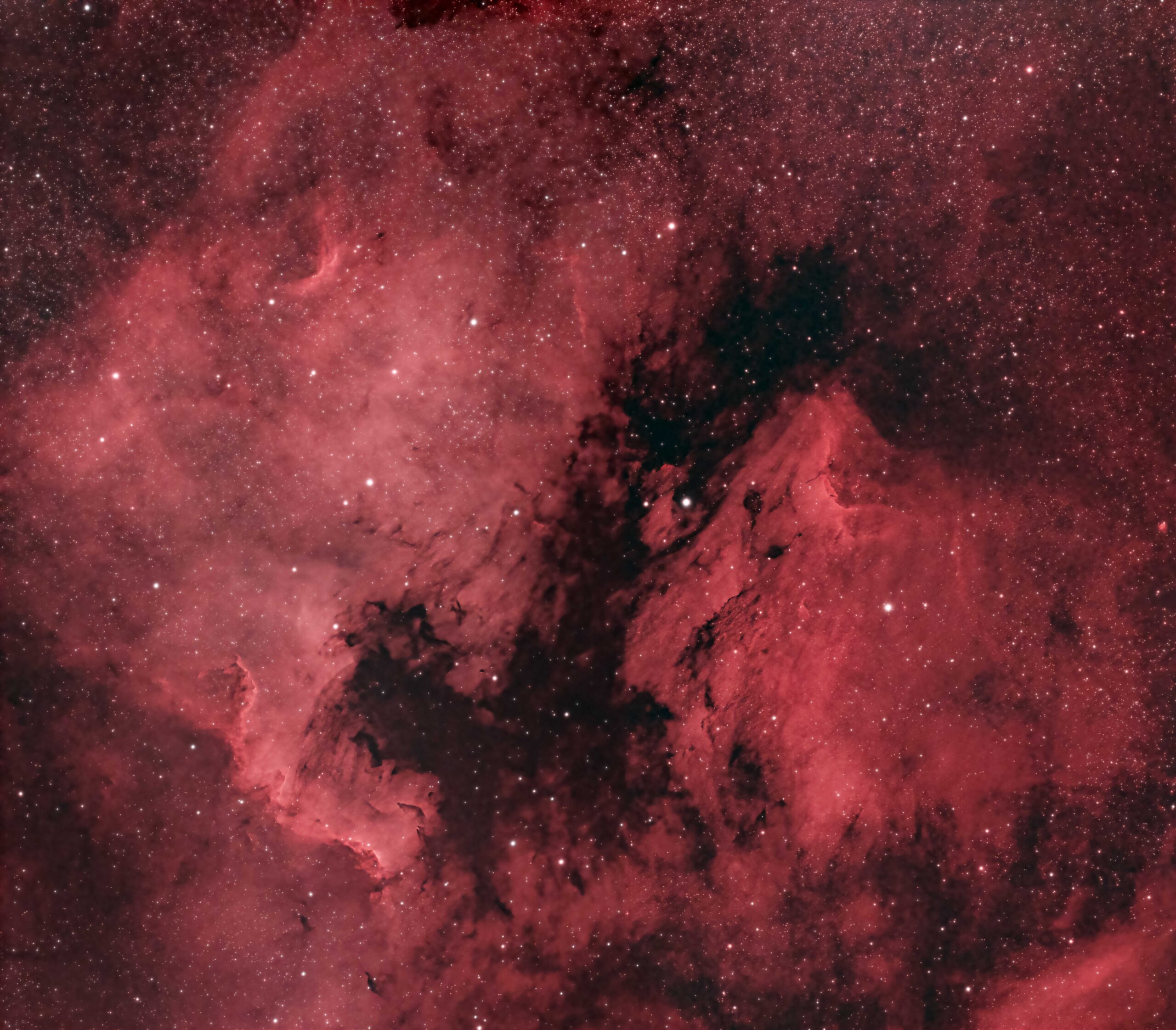
And finally, the patience and efforts paid off. This is my first two-panel mosaic in the world of astrophotography with an integration of 9 hours 45 minutes.
The most important thing that this field has taught me is ‘patience’, without which even the backbreaking efforts would be in vain. Without patience and exertion, the destiny will always be far beyond one’s reach. We do not control the time, but we certainly have a full control over our mind and senses, which dictates our actions. If you have made a resolve, then it becomes your duty to see that it sees the light of the day. Nothing is more sacred than fulfilling your duties. This plan of mosaic was my dream and to manifest that dream, I had to make a resolution.
Knowing that the regions in our galaxy I capture, could be or become a home for another life form, I no longer see the night sky as I used to see it before. May the blessings of millions of suns be upon you all. Clear skies to all!