Obeisance to eternity.
Is the universe finite? If yes, then how big is the shell? Because no one knows how far the edge extends to, if there is any. If this universe is indeed finite, then how many of them are there? Undoubtedly, science has limits too. We can get close to this material knowledge, but can never understand the vastness of the material creation in its full glory. The universe will always remain infinite for its residents.
Universe is governed by time. The future is not as important as the past, because we do not know where time will lead us. We know the present, and we keep looking back in time to know our origin. After all, everything rests upon Time. No one knows how and from where it all came into being, and perhaps no one will ever. The story of genesis will always be the greatest mystery, possibly not meant to be unravelled.
Around 4000 years ago
Nestled in a brighter arm of our galaxy, lies a huge region mainly dominated by the ionised hydrogen gas and dust, responsible for creation of stars. Lagoon nebula is bright with apparent magnitude of 6.3 making it faintly visible to the naked eye under dark sky. Lagoon and Triffid nebulae are situated approximately 4000 light years away from earth in the constellation Sagittarius, and are one of the favourite targets of the astrophotographers during the summer nights.
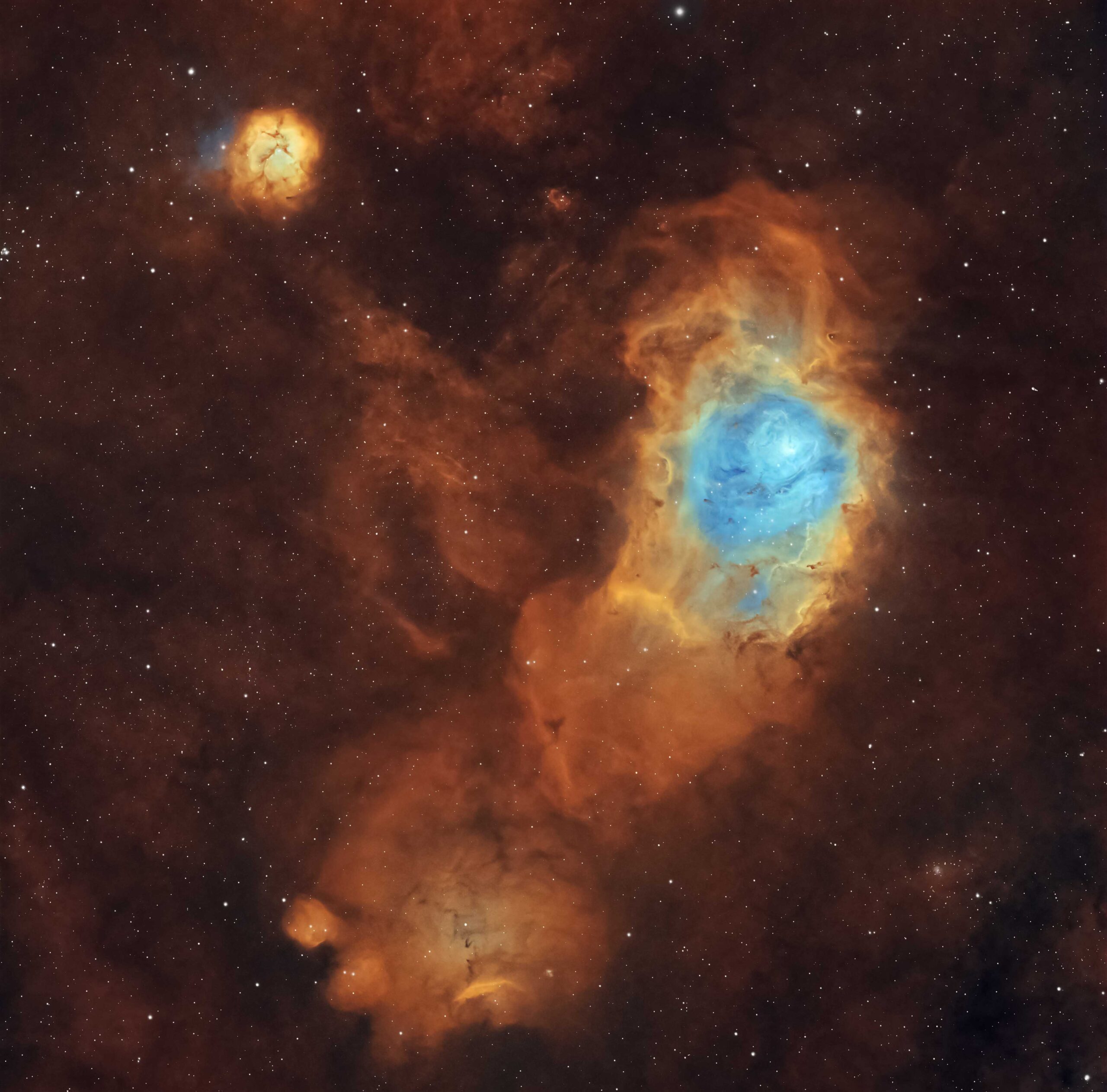
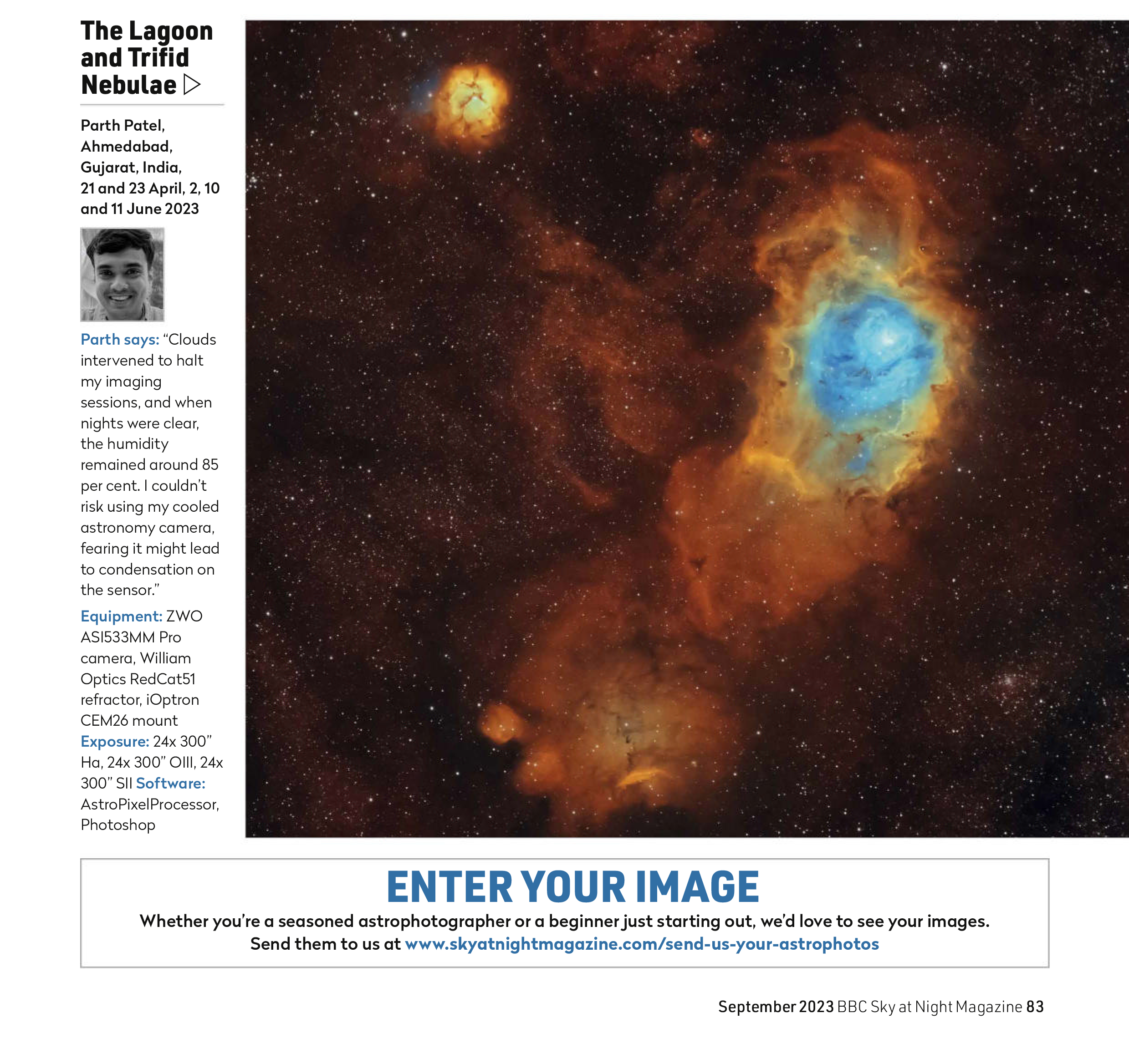
I had captured this image in summer of 2023, when I was new to the monochrome camera along with the narrowband filters. This is the integration of 2 hours per filter, totalling to 6 hours from my city (Bortle class 9).
Image Acquisition:
Telescope: William Optics Redcat 51
Camera: ZWO ASI 533MM PRO
Optolong 7nm filters (Ha, Oiii and Sii)
Each exposure was 5 minutes long.
The focal length of my telescope being 250mm, is considered as wide field refractor in astrophotography, but at the same time the sensor size of my camera being just 1 inch, is quite forgiving and gives a much decent view of the target. These regions in space are so massive that even a 250mm kit lens with DSLR can capture many nebulae and some galaxies as well.
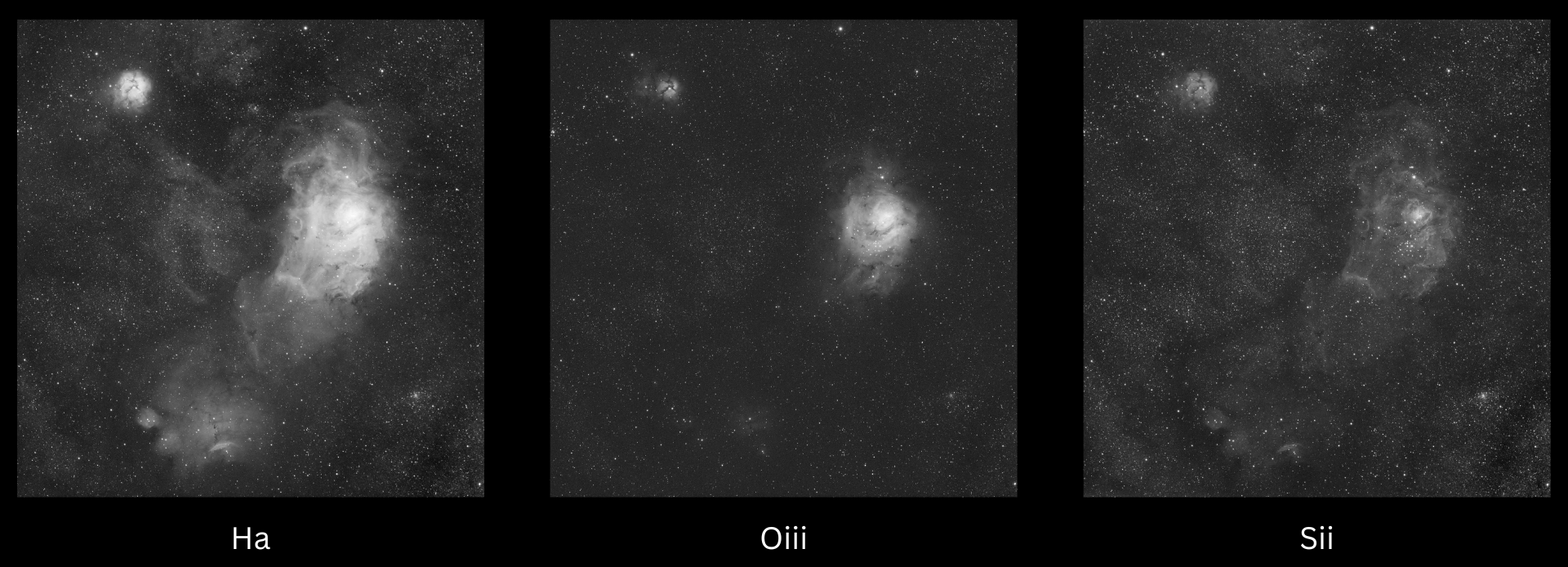
Below are the raw images from three different filters, after stacking the data in the Astro Pixel Processor. Each image is the stack of 2 hours data from light polluted area. This is just to give an example to the general viewers who are not into this hobby, on how these three filters help me capture specific wavelength of light, by blocking artificial lights. First image is from hydrogen alpha channel, second and third images are from Oxygen and Sulphur channels respectively. These images are then combined in a software to produce a colour image and then, the real pain of post-processing begins.
These dust and gases are the ingredients from which new stars are born. These nebulae are visible because of the light scattering from the nearby stars, and that light is narrowed down to a specific wavelength with the help of a particular filter.
Post-processing of the monochrome data is quite tricky, but I love testing different work flows in Pixinsight and Photoshop. I had captured two different targets before this one viz. Rosette Nebula and Orion Nebula, so I knew this would be quite challenging too. I find capturing data to be far easier than post-processing because sleepless nights are more manageable than seeing your initially processed image of any target (at least in my case). I have never been satisfied with the initial result, and most of the images I share on social media are second or third attempt in editing. That being said, the colour image of Lagoon & Triffid that I posted above, is my second attempt at editing. In the re-processing, I have reduced the number of stars with a view to bring out the nebulosity. This region in our galaxy is covered with thousands of stars making it quite difficult to emphasise the nebula.
This was a planned target and I wanted to capture more data but as far as I remember, I had to limit it because of the forecast. Cloudy nights were to take over the city, so I had decided to limit it to 2 hours each filter as it did not require longer integration to bring out the nebulosity due to its brightness.
All His blessings
I believe that the Universe is neither beginning-less nor a self-sustaining entity. The precise amount of gravity keeping everything in tact and revolving, making life possible and thrive on a planet, the tilt of earth causing different seasons, the life cycle of an individual, the defence mechanism of our own body, the absorption of nutrients for growth and sustenance, etc., everything that happens is in an orderly fashion. It’s even beyond perfection. It certainly requires a designer for this masterpiece. I cannot imagine the realm beyond this shell.
The illusory power which has created this universe, is exceedingly difficult to overcome, but at the same time, it’s enchanting. It’s totally worth getting up in the middle of the night in summer and pointing the scope to the outer world. There’s no regret. And believe me, the moment you capture these for the first time, you will feel a great accomplishment. I invite you all to fall into this rabbit hole and start looking up!
Once again, the time has come for these giant summer nebulae to rule our night sky, and I wish you all clear skies!