Whispers from the ethereal sky,
where dreams attain singularity and
time becomes futile.
Obeisance to the eternity. Far beyond our reach, lie so many worlds that we might never see. They are so distant that even if we travel at the speed of light, it will take millions of years to reach there. Even a neighbouring galaxy seems infinitely distant – let alone trillions of distant galaxies. How big our universe is! But, I do believe humans will venture into deep space, but going beyond our galaxy remains unfathomable.
I began my journey in astrophotography from the year 2017, and somewhere in 2018, I had made first attempt to photograph our two neighbouring galaxies Andromeda and Triangulum from our farm using Canon 50mm lens coupled with Canon 600D. Both the galaxies were a perfect fit in the frame, but I had no idea about the basics of deep sky imaging. All I knew was to take multiple exposures and stack them with few curve adjustments in photoshop. I had no idea about the filters that are available in the market that would tackle the light pollution, or how to process the image or how much data is required for a decent image. Final image was a disaster.
Years later, I again made an attempt to capture Andromeda galaxy with a dedicated astrophotography gear i.e., iOptron sky-guider pro to track the stars, ZWO ASI 183MC PRO camera and Redcat 51 telescope with a light pollution filter. Even with a dedicated astrophotography gear, I faced a new challenge viz. walking noise. Walking noise or raining noise is a fixed pattern noise when the field of view drifts from exposure to exposure. It happens with most of the camera sensors. To avoid this, I needed a guide scope and a guide camera which would send a command to the equatorial mount to move slightly by few pixels in random direction in order to break the pattern. This is known as ‘dithering’. So again, the attempt failed. Although, I do not consider those few hours of my life to be a waste, because dithering is an integral part of the whole imaging session for all deep sky objects. I had learnt something new.
Four years later
I switched to monochrome camera and got all the filters that are required to capture broadband and narrowband targets. I had everything, and there was no place left to put the blame. This was a dead-serious attempt! I collected 7 hours data from Bortle Class 8, and this is the final result…
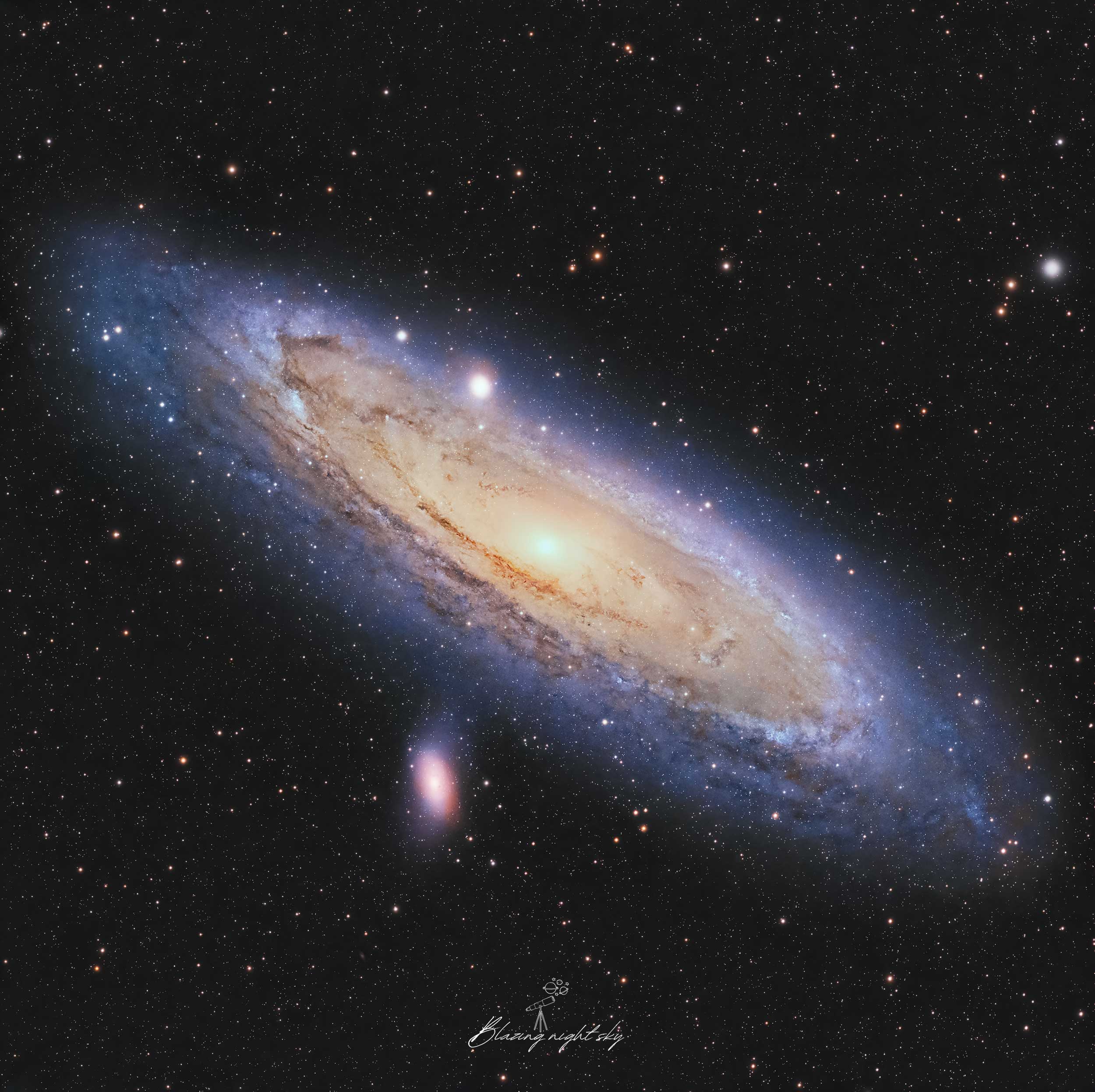
How blissfully it floats in this vastness! The immensity of the creation is such that even this galaxy appears as nothing more than the size of a grain of sand on the infinite shore. It reminds me of a story when Lord Krishna had opened his mouth and mother Yashoda beheld the entire creation within. The fact that at a distance of 2.5 million light years this galaxy fits perfectly in the frame at just 250 mm focal length with 1″ sensor, still amazes me. Andromeda galaxy also has its own satellite (dwarf) galaxies, of which M110 is visible in this photo, just below the main galaxy. We also have 2 satellite galaxies viz., Large Magellanic Cloud (LMC) and Small Magellanic Cloud (SMC), which are visible from southern hemisphere, located at a distance of 1,60,000 and 2,00,000 light years away respectively.
The stars you see in this image belong to our galaxy. There is vast region of void between galaxies, which is called Intergalactic Space, that stretches millions of light years across, but these regions do contain ionized hydrogen gas along with other elements, possibly left over from the Big Bang.
Let’s go a bit further…
About 2.8 million light years away, lies another major galaxy called Triangulum Galaxy, which is the third largest galaxy in the local group of galaxies, following Andromeda and our Milky Way. Both Andromeda and Triangulum galaxies appear close to each other in our night sky and thus, both the galaxies are a perfect fit in one frame when you have an APS-C or full frame sensor with 250mm focal length telescope or lens. As of now, my camera has 1″ sensor, so I had to capture both the galaxies separately.
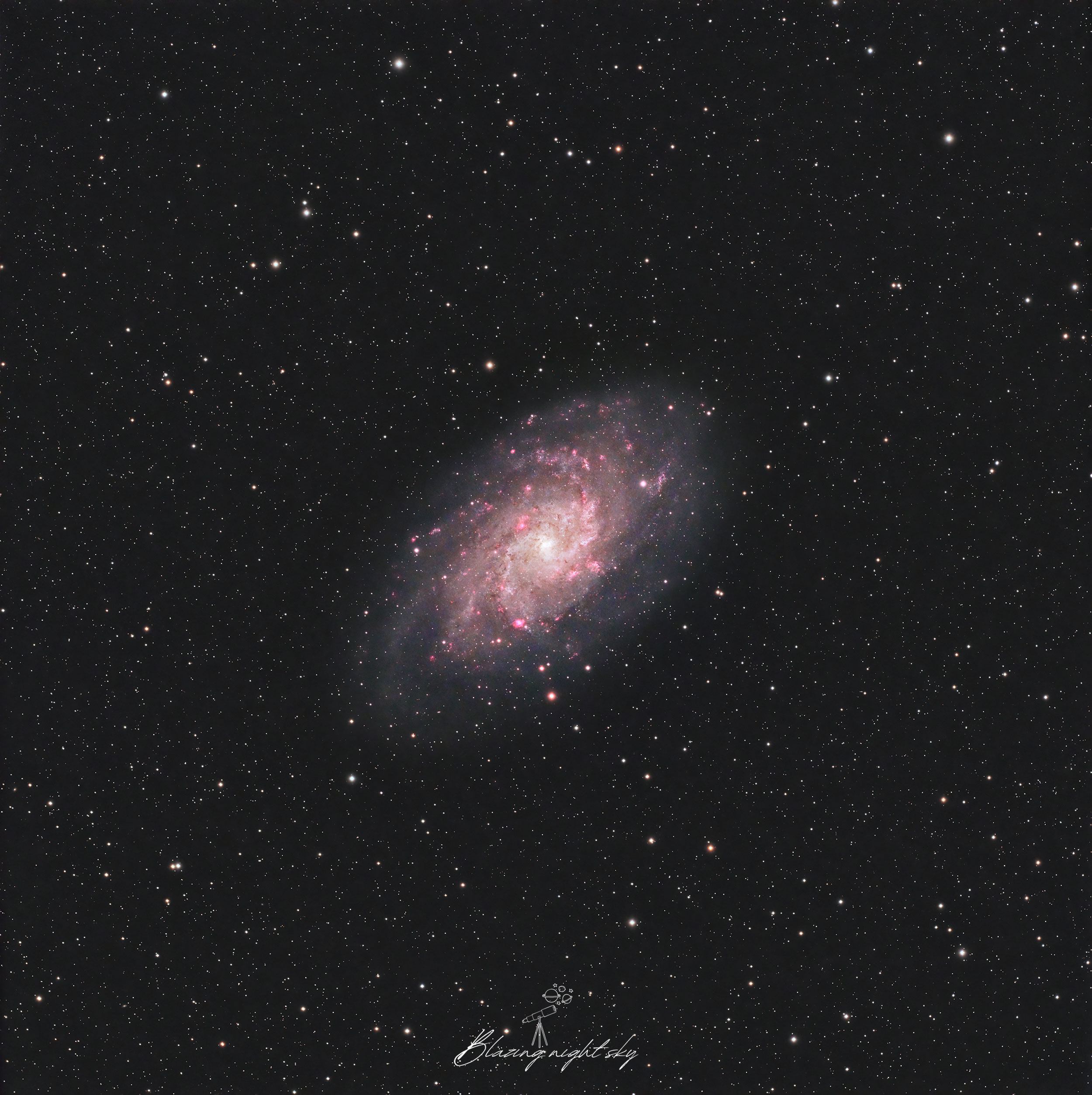
This is the result of 10 hours of integration from Bortle 8 area. Out of 10 hours, 7 hours data is captured using broadband filters (LRGB), while 3 hours data is collected through hydrogen alpha filter. Allow me to explain in simple terms. Broadband filters i.e., L (Luminance), R (Red), G (Green) and B (Blue) are for the monochrome cameras. They are not light pollution filters, as they do not cut the artificial light (street lamps, etc.) like the narrowband filters. Luminance filter is the same as UV/IR cut filter which is used by many photographers, primarily, for sharpness. This L filter collects all the details of the object by letting in most of the visible light, while RGB filters are typically used to paint the black and white image that Luminance (L) filter produces. This set of LRGB filters is used for capturing galaxies and star clusters and sometimes, nebulae too.
Here, both the galaxies are captured using LRGB filters. But, Triangulum galaxy also contains data from Hydrogen alpha filter, which is a narrowband filter. This is very common amongst the astrophotographers to use both broadband and narrowband filters for galaxies. The purpose is to reveal the details of nebulae in another galaxy, which an LRGB filter set cannot do. So, I took 3 hours of H-alpha data and processed the image of Triangulum galaxy. Zoom into the image, and you will see small pink structures in the galaxy. Those are the star-forming regions (nebulae) in the Triangulum galaxy. Those pixels are 2.8 million light years old!
I am sure the life forms in that galaxy are out there taking pictures of nebulae in our galaxy too. Honestly, intergalactic imaging beats intergalactic war. At least with telescopes and cameras, no one gets vaporized.
As I mentioned earlier that in 2018, I had tried to capture both the galaxies in a single frame using 50mm lens. Let me show you how these galaxies are placed in our night sky.
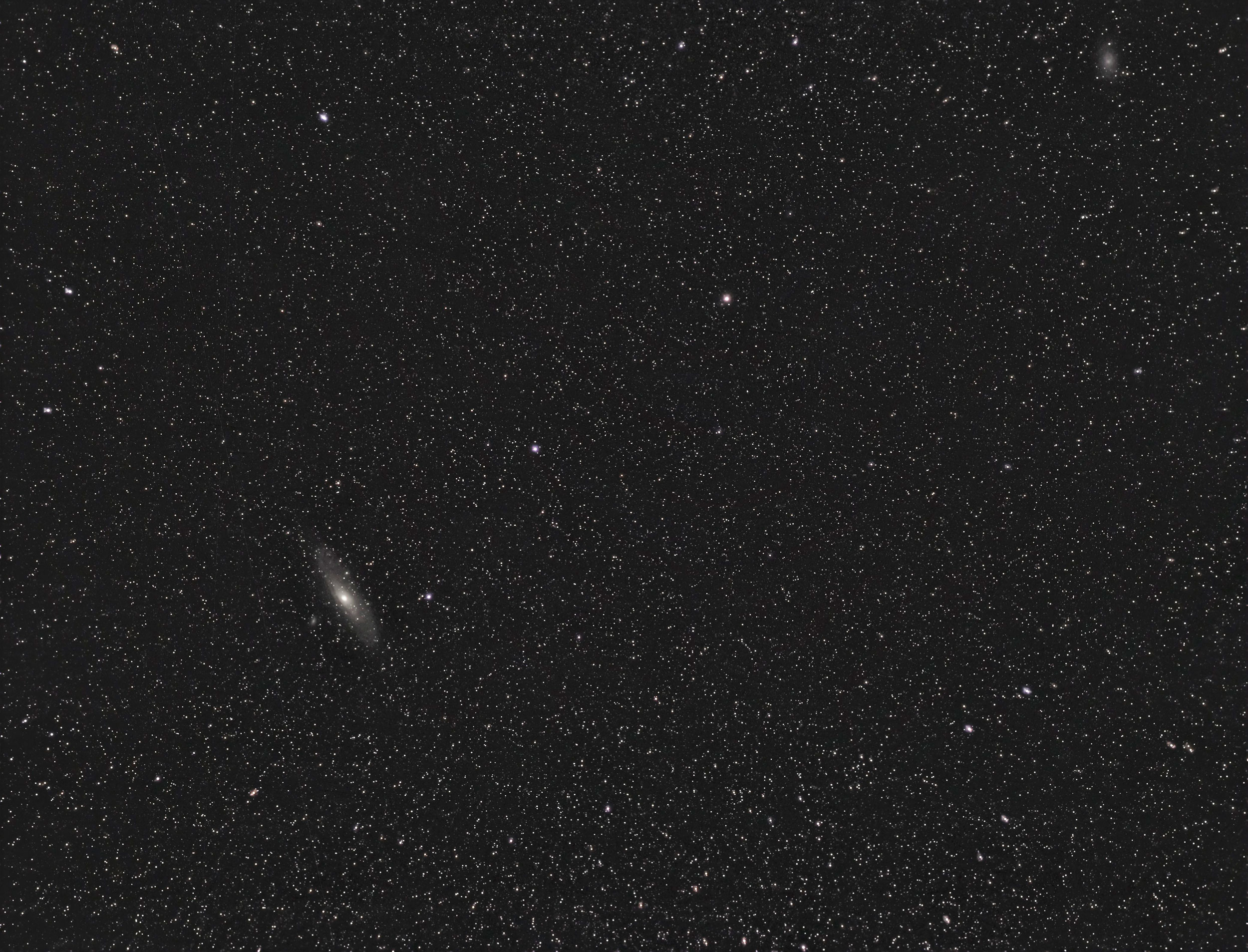
On top right corner, you can see the Triangulum galaxy and on the left side, Andromeda galaxy stands out. This is how close they appear in our night sky and can be captured in one frame using right gear. I shot this image using Canon 600D with 50mm lens. As far as I remember, the data collected was not even of 30 minutes. So, you won’t find any details here. At least, I could use this image as reference to show their placement in our night sky.
I had captured this last image without any professional gear. Just a small tripod, a DSLR and 50mm lens, can do the magic. Be sure to capture as many exposures as you can. Take at least 1000 shots in a dark sky location by setting the exposure at 4″ at ISO 800 with wide aperture. I am sure that you will get way better result than the image above.
As the leaves begin to fall, a chilly breeze wraps around you, and the hunter of our night sky ascends – know then, the season of Andromeda and Triangulum has arrived.
Clear skies to all!